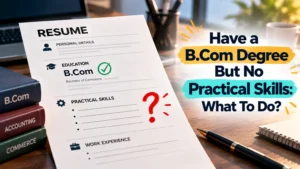

You studied for three years. You attended lectures, wrote examinations, cleared subjects, and collected your B.Com degree. You did everything the course required of you.
Then you walked into your first interview, and the interviewer asked you to show them how you would process a GST entry in Tally. Or prepare a basic MIS report. Or explain how a bank reconciliation statement works in practice, not in theory.
And you realized, with a quiet clarity that nobody prepares you for, that your degree taught you what accounting is. Not how to do it.
This is not a personal failure. It is one of the most common experiences of B.Com graduates across Maharashtra and across India. And more importantly, it is fixable.
Why This Happens: The B.Com System Was Built for Something Else
The B.Com curriculum, as designed by most universities including SPPU, is an academic program. Its purpose is to build conceptual understanding of commerce, accounting, finance, economics, business law, and taxation. It is examined through written papers that test whether you understand the principles involved.
That is a legitimate goal. The principles of accounting, the framework of GST, the structure of financial statements, these are foundational knowledge that matters. But the curriculum was not designed to produce job-ready professionals in three years. It was designed to produce graduates who understood commerce well enough to go further, into CA, MBA, government service, or further specialisation.
The problem is that most B.Com graduates today are not going further immediately. They need to work. And the job market is not testing their theoretical understanding of accounting. It is testing whether they can do the work.
Those are two different things. And the B.Com curriculum, however thorough, does not bridge that gap.
What Companies Actually Check in an Interview
When a company interviews a fresh B.Com graduate for an Accounts Executive or Finance Executive role, here is what they are actually evaluating.
Can you operate Tally? Not describe it. Open it, create a voucher, record a transaction, generate a report.
Do you understand GST in practice? Filing a return, reconciling input tax credit, reading a GSTR report.
Have you worked with MIS? Not "I know what MIS reporting is." But can you build a basic MIS dashboard in Excel or interpret one accurately?
Can you do a bank reconciliation? Not the textbook definition. The actual process, with real numbers, in a real spreadsheet.
How is your communication? Can you explain a financial discrepancy to a non-finance colleague? Can you present a brief financial summary to a manager?
A B.Com curriculum covers the concepts behind all of these. It does not, in most cases, build the applied ability to actually perform them in a corporate environment. That is the gap.
What Practical Skills You Are Actually Missing
The skills that B.Com graduates consistently lack when entering the job market are not mysterious or advanced. They are the applied, daily-use competencies of entry-level accounting and finance roles.
Tools:
- Tally Prime (the full accounting cycle, not just theory)
- Advanced Excel (pivot tables, VLOOKUP, financial formulas, dashboard building)
- GST portal navigation and live filing
- Basic SAP or ERP familiarity
Processes:
- GST filing, TDS computation, income tax basics in practice
- Bank reconciliation with real numbers
- MIS report preparation and interpretation
- Financial documentation and voucher entry
Professional:
- Business communication in writing and in person
- Professional email and reporting standards
- Interview preparation and presentation skills
- Basic understanding of corporate accounting workflows in a real company
Most of these are learnable in months, not years. The reason B.Com graduates do not have them is simply that the degree program did not build them, not because the graduate lacked the ability.
The Reality Check: Your Degree Is Not the Problem
Here is the important clarification: your B.Com degree is not useless. The companies hiring for accounts and finance roles specifically require graduates who understand accounting principles, GST frameworks, business economics, and financial concepts. Your B.Com gave you that foundation.
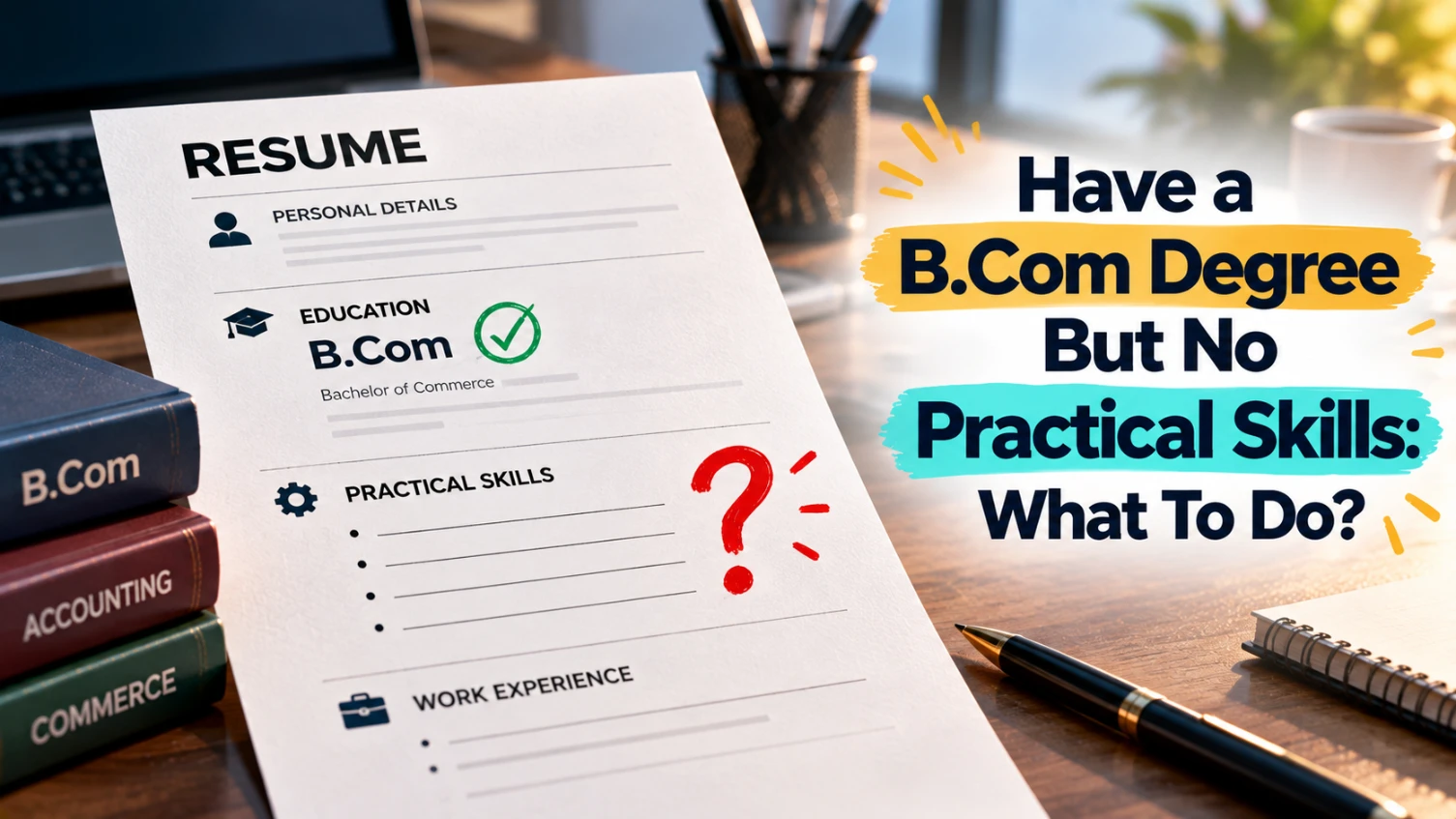
What your B.Com did not give you is the layer of applied skills that goes on top of that foundation. The tools. The processes. The professional readiness. The confidence that comes from having actually done the work, not just studied it.
That layer is what employers mean when they say "we need someone who can hit the ground running." They are not asking for ten years of experience. They are asking for someone who does not need three months of internal training before they can be useful.
That is a specific and solvable gap.
How to Bridge the Gap
The most direct route from "B.Com with no practical skills" to "job-ready for accounts and finance roles" is a structured professional diploma that builds exactly what your degree left out.
Not a Tally course. A Tally course gives you one tool. Employers want someone who can work across the full range of corporate accounting responsibilities.
Not an MBA. An MBA is two more years of academic education, and while it has value, it does not specifically address the entry-level practical gap you are facing right now.
What works is a focused, intensive program that covers corporate accounting workflows, live tool training, GST and taxation in practice, MIS reporting, professional communication, and placement preparation in a compressed, job-oriented format.
How Nilaya Education Addresses This Specifically
At Nilaya Education, Pune, this exact gap is what our Corporate Accounts Management (CAM) program was built for.
CAM is a 7-month fast-track professional diploma designed specifically for B.Com graduates who have the theoretical foundation but need the applied layer to become job-ready. The curriculum covers Tally Prime, advanced Excel, GST filing, TDS, income tax compliance, MIS reporting, banking operations, and professional communication through live projects, tool labs, and real corporate accounting scenarios.
Students who complete CAM are not just certificate holders. They have worked with the actual tools, prepared actual documentation, and gone through structured interview preparation. They can answer the interview questions that most B.Com graduates cannot.
For graduates who want to target senior accounts and finance roles including Accounts Manager and Finance Manager positions, our Finance Manager program builds on this foundation with SAP FICO, Power BI, advanced MIS, and financial analytics.
Since 2008, we have placed over 10,000 students at companies including Deutsche Bank, KPMG, EY, ICICI Bank, and Kotak Mahindra Bank. Every program carries a 100% Placement Guarantee on Stamp Paper.
Conclusion
Having a B.Com degree without practical skills is an uncomfortable position to be in. But it is a position that has a clear and well-trodden path out of it.
The degree gave you the foundation. The knowledge is there. What is missing is a focused, applied program that builds the tools proficiency, process knowledge, and professional readiness that your degree did not prioritise.
That is not a three-year problem. With the right program, it is a seven-month solution.
To know more about how the CAM program bridges this gap, visit nilayaeducation.org or call +91 97 3000 5000.