

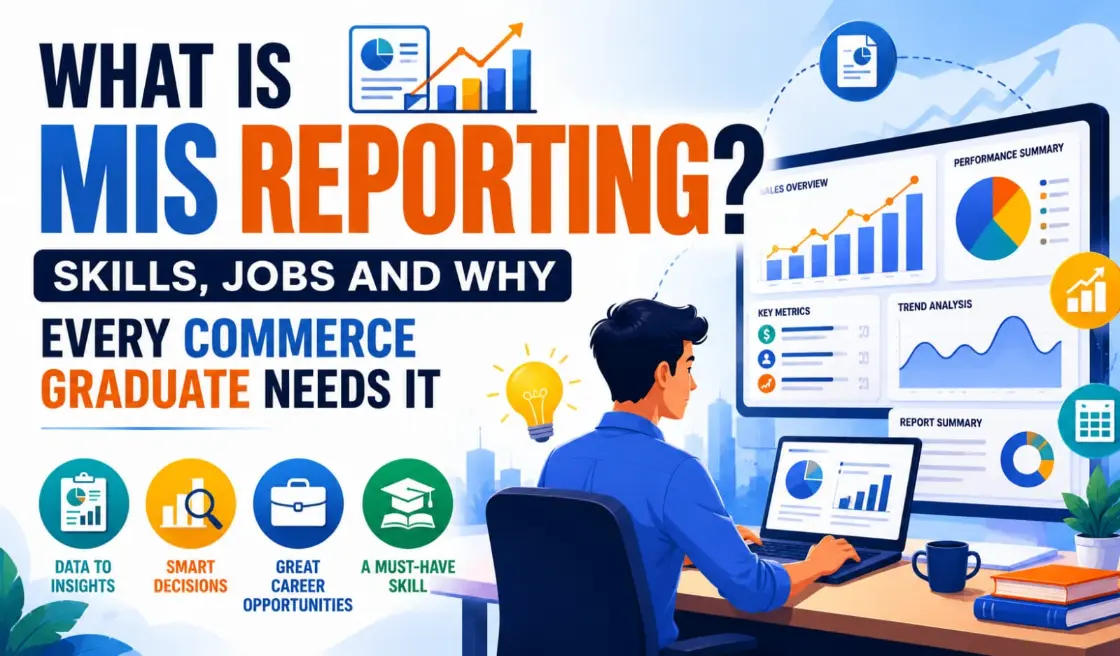
Ask ten fresh commerce graduates what MIS reporting means and most will give you a vague answer. Ask the same question in a corporate finance or accounts department and the answer is immediate - it is one of the most essential tasks performed every week, in almost every organization across India.
This gap between what commerce education covers and what corporate environments actually run on is exactly why MIS reporting is worth understanding before you graduate - not after you have already missed it in your first few interviews.
What Is MIS Reporting?
MIS stands for Management Information System. MIS reporting refers to the process of collecting, organising, and presenting business data in a structured format so that management can make informed decisions.
MIS reports convert raw business data into structured insights across finance, sales, HR, operations, and compliance - enabling better decision-making at every level of an organisation.
In simpler terms: companies generate enormous amounts of data every day - sales figures, expense records, production numbers, cash flows, inventory levels, and more. Without a system to organise and present this data meaningfully, management would be making decisions in the dark. MIS reporting is the system that brings that data into a readable, usable format.
In the context of accounting specifically, MIS reporting focuses on generating financial reports and providing insights related to financial data and performance - including financial statements, budgetary analysis, variance analysis, and key performance indicators (KPIs). These reports act as a compass for financial management, guiding decisions about where resources should go and where risks are building up.
What Does an MIS Report Actually Contain?
An MIS report is not a single standard document - it varies by function and organisation. However, most financial MIS reports share a common structure.
A standard financial MIS report typically includes:
Income Statement Data - Revenue, expenses, and net profit for the reporting period, showing how the business is performing financially against targets.
Balance Sheet Summary - The organisation's assets, liabilities, and equity position, giving management a snapshot of financial health.
Cash Flow Analysis - Inflows and outflows of cash, showing whether the business has sufficient liquidity for its operations.
Key Performance Indicators (KPIs) - Metrics and financial ratios that measure performance against specific business goals.
Forecast vs Actual Comparison - A comparison between what was planned and what actually happened, identifying where the business deviated from its targets and why.
Variance Analysis - The analysis of differences between budgeted and actual figures - one of the most important analytical tools used in corporate finance and accounts teams.
The frequency of MIS reporting varies - daily operational reports track immediate business activity, weekly reports summarise short-term trends, and monthly reports provide a consolidated view of overall financial performance.
Why Companies Depend on MIS Reporting
MIS reporting identifies, monitors, and evaluates all of a company's day-to-day operations. It delivers a concise view of business performance, financial condition, and employee performance, ensuring that management can make proactive decisions rather than reactive ones.
For Indian businesses specifically, MIS reports serve a dual role: supporting internal decision-making and meeting requirements set by lenders and banks when evaluating business loan applications. Accurate MIS reporting also simplifies GST filings, TDS compliance, and audit preparation - making it directly connected to the compliance and regulatory work that most finance teams handle on a monthly basis.
This is why MIS reporting is not just a technical skill - it is a business-critical function that touches finance, operations, compliance, and strategy simultaneously.
What Skills Does MIS Reporting Require?
Understanding what MIS reporting is matters. Understanding what skills it requires is what helps you build a career around it.
Advanced Excel Proficiency The majority of MIS reporting in Indian companies - particularly in mid-sized businesses and SMEs - is done in Microsoft Excel. Pivot tables, VLOOKUP, data validation, conditional formatting, charts and dashboards, and formula-based automation are the core tools of MIS work. Most MIS roles require expert-level Excel skills including working knowledge of macros, pivots, and data manipulation techniques.
Financial and Accounting Understanding MIS reporting in a finance team requires the ability to read and interpret financial statements - balance sheets, P&L accounts, cash flow statements. Without understanding what the numbers mean, an MIS executive can compile data but cannot analyse it or explain what it indicates to management.
Data Collection and Organisation Companies pull data from multiple sources - accounting software, CRM systems, ERP platforms, and sales tools. An MIS executive needs to know how to collect, clean, and consolidate this data reliably before building reports from it.
Analytical Thinking and Variance Analysis The most valuable part of MIS reporting is not compiling the data - it is identifying what the data means. This requires the ability to spot trends, compare actual performance against forecasts, and flag variances before they become larger problems.
Knowledge of Accounting Software and ERP Tools Tally, SAP, and other ERP systems are commonly used in corporate finance environments, and MIS reports are often generated from data held in these systems. Working familiarity with these tools significantly improves an MIS executive's productivity and accuracy.
Attention to Detail and Reporting Accuracy Management makes decisions based on MIS reports. An error in data or a misrepresented figure can lead to a wrong decision at the senior level. Accuracy and data discipline are non-negotiable in MIS roles.
MIS Executive Jobs and Salary in India 2026
MIS roles exist across industries - banking and financial services, manufacturing, retail, FMCG, IT, and logistics. Any organisation that generates financial data and needs to report it upward has a need for MIS capability.
Based on salary data published on Glassdoor as of May 2026, the average salary for an MIS Executive in India is approximately ₹2.1-2.5 LPA at entry level, with the typical pay range sitting between ₹1.85 LPA (25th percentile) and ₹3.6 LPA (75th percentile) nationally.
Indeed India's salary data, updated February 2026, reports an average monthly salary of ₹20,314 for MIS executives across India.
Salaries grow significantly with experience. According to ERI SalaryExpert, senior MIS and management information professionals with 8+ years of experience reach substantially higher compensation levels. ERI's MIS Manager data shows the average pay for an MIS Manager at ₹25.9 LPA, with the range spanning ₹17.6 LPA to ₹31.7 LPA - a clear indicator of the long-term career trajectory this skill set can support.
Common job titles that require MIS reporting skills include:
- MIS Executive
- Accounts Executive (with MIS responsibility)
- Finance Executive
- Business Analyst
- Data Analyst (Finance)
- Financial Reporting Analyst
- Management Reporting Specialist
Why Every Commerce Graduate Needs This Skill
Here is the reality of the first year of a commerce graduate's career in accounts or finance: you will be asked to prepare reports, compile numbers, analyse variances, and present data to senior team members - often within the first weeks of joining.
Companies do not have time to train new hires from scratch on how financial reporting works. They expect graduates to come in with at least a working understanding of what MIS means, how reports are structured, and how to work with the tools used to build them.
This is precisely why MIS reporting is not optional knowledge for commerce graduates entering finance, accounts, banking, or business operations roles. It is table-stakes competency - the baseline that separates candidates who are immediately useful from those who require six months of on-the-job learning before contributing.
How Nilaya Builds MIS Reporting Into the Curriculum
At Nilaya Education, MIS reporting is not a theoretical topic covered in a single lecture. It is one of the core practical modules built into the Smart B.Com + CAM (Corporate Accounts Management) program and the CAM Professional Diploma.
The CAM curriculum includes intensive, hands-on training in MIS reporting as part of its Core Accounting and Taxation Training - alongside GST filing, income tax compliance, banking operations, and financial documentation. Students learn to prepare MIS reports using real tools and real financial data, not textbook exercises.
This approach means that Smart B.Com + CAM graduates enter the workforce with working familiarity in MIS reporting - the actual skill employers are looking for when they post Accounts Executive, MIS Executive, and Finance Executive roles. Combined with Tally, advanced Excel, and broader accounting knowledge built through the program, it positions students to contribute from the first week of employment rather than spending their initial months learning what they should have learned in college.
Nilaya's 100% placement guarantee - backed on stamp paper - and a track record of 10,000+ placed students since 2008 reflects the real-world value of this practical, skills-first approach to commerce education.
Conclusion
MIS reporting is one of those skills that sounds technical but is fundamentally about one thing: turning data into decisions. Every finance team uses it. Every accounts department depends on it. And every commerce graduate who wants to be genuinely useful - not just theoretically qualified - needs to understand it before stepping into the corporate world.
The students who enter their first job knowing what MIS means, how reports are built, and how to use Excel to compile and present financial data have a clear, immediate advantage. Building that knowledge starts in the program you choose - not after graduation.
To know more about the Smart B.Com + CAM and CAM Professional Diploma at Nilaya Education, visit nilayaeducation.org or call +91 97 3000 5000.