
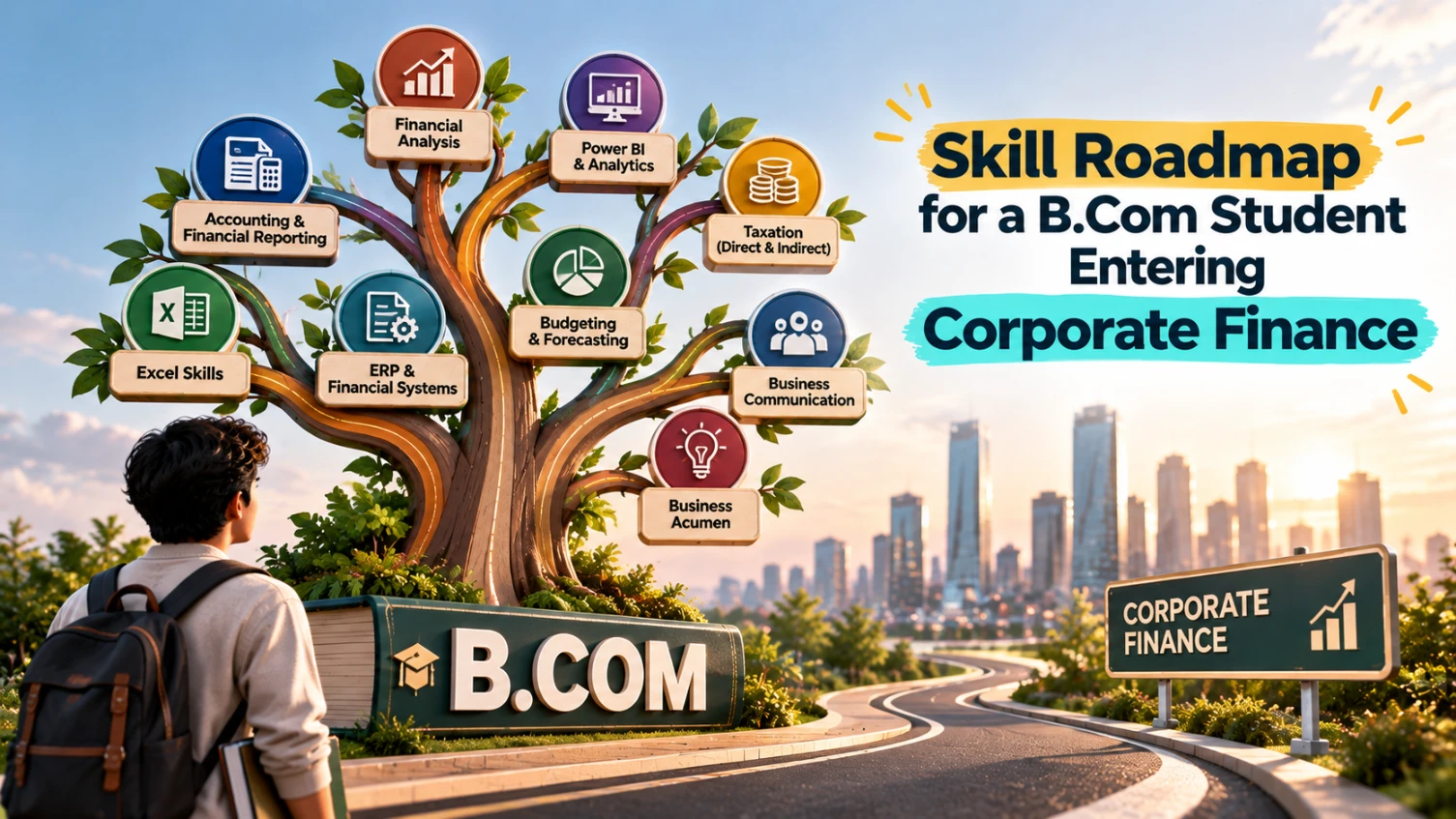
You are somewhere in your B.Com journey, or you have just finished it, and you know you want a career in corporate finance. Not a vague "something in accounts" but an actual role inside a company's finance team: managing accounts, handling compliance, working on financial reporting, building MIS dashboards, or moving into financial analysis over time.
The problem is that nobody has told you exactly what you need to learn to get there. Your college syllabus covers the concepts. Placement drives on campus offer generic preparation. And the internet gives you seventeen contradictory lists of "skills for finance."
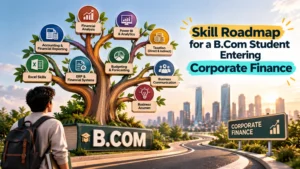
This is a single, clear roadmap. What to learn, in what order, and why each stage matters.
First: Understand What Corporate Finance Actually Is
Corporate finance is not a single role. It is a function inside a company that manages how money comes in, how it goes out, how it is reported, and how it stays compliant with regulations.
An entry-level person in corporate accounting and finance works with accounts receivable and payable, prepares journal entries and ledgers, handles GST and TDS compliance, prepares MIS reports, manages bank reconciliations, and supports the finance team with data compilation and analysis.
Understanding this is important because your roadmap should lead to these specific activities, not to a generic sense of "being good at finance."
Stage 1: Solidify Your Accounting Foundation
What you already have: If you are in or have completed B.Com, you have a conceptual understanding of financial accounting, double-entry bookkeeping, balance sheets, profit and loss accounts, and basic taxation. This is your foundation. It is real and it matters.
What you still need: The ability to apply these concepts in a working environment. Most B.Com graduates can describe what a bank reconciliation statement is. Fewer can actually prepare one with real transaction data and identify the discrepancies. The gap between knowing and doing is what this roadmap is built to close.
Action: Before moving to tools, make sure you can work through real accounting problems without referring to a textbook. Practice preparing trial balances, ledgers, and basic financial statements using sample data. This ensures your foundation is solid before you build on it.
Stage 2: Master the Core Tools
This is where most B.Com students fall behind in the job market. Tools are what employers check first in interviews, and they are what you will use every single day in a corporate role.
Tally Prime
Tally is the accounting software used by the vast majority of Indian businesses, from SMEs to mid-sized companies. You need to know how to create vouchers, process transactions, manage ledgers, generate reports, and reconcile accounts in Tally. Not a surface familiarity. Working confidence.
Advanced Excel
Excel is used daily in finance for everything from basic data compilation to financial modelling. The skills that matter in corporate finance specifically are: VLOOKUP, HLOOKUP, INDEX-MATCH, pivot tables, conditional formatting, and basic financial dashboards. These are learnable, and every finance team uses them.
GST and Tax Portals
India's taxation system is now portal-based. You need to be able to navigate the GST portal, understand how GSTR forms work, know the difference between GSTR-1, GSTR-3B, and GSTR-2A, and understand basic input tax credit reconciliation. TDS challan filing and income tax basics round out this layer.
Stage 3: Build Corporate Process Knowledge
Tools without process understanding produce someone who can operate software but cannot function in a finance team. This stage is about understanding the workflows that corporate finance runs on.
MIS Reporting
Management Information System reporting is one of the most common responsibilities of entry-level finance professionals. Understanding MIS reporting, how to compile data from multiple sources, structure it into a usable report, and present it accurately to management, is a skill that significantly improves your interview performance and your effectiveness in the first months of work.
Banking Operations
Know how NEFT, RTGS, and IMPS work. Understand how bank statements are used in reconciliation. Know what a bank reconciliation statement looks like and how to prepare it with real data.
Financial Documentation
Corporate finance involves a great deal of documentation: purchase invoices, sales invoices, debit notes, credit notes, payment vouchers, receipt vouchers. Understanding what each document is for, how it is processed in accounting software, and how it flows through a company's financial records is fundamental to functioning in a finance role.
Stage 4: Add the Advanced Layer
Once stages 1 to 3 are solid, this is where you move from entry-level ready to mid-level potential.
SAP Basics
Larger companies and MNCs use SAP for their financial operations. Even a working familiarity with SAP FI (Finance) gives you an advantage for roles at companies that run on it. SAP FICO is specifically valuable for roles in financial control and management reporting.
Power BI
Power BI is rapidly becoming the standard tool for financial dashboard building and management reporting in Indian corporate finance. A finance professional who can build a live financial dashboard in Power BI is operating at a different level from one who still compiles data manually. As a skill to develop after Stage 2, Power BI extends your value significantly.
Financial Analysis Basics
Moving beyond data compilation into data interpretation: reading financial ratios, understanding what variances in a P&L indicate, and being able to explain financial performance to a non-finance manager. This is the bridge from an accounts executive function to a financial analyst function over time.
Stage 5: Build Your Professional Readiness
Technical skills get you to the interview. Professional skills get you through it and through the first six months on the job.
Business Communication: Writing professional emails, presenting data clearly in meetings, and discussing financial information with non-finance colleagues are daily requirements in corporate roles.
Interview Preparation: Finance interviews test specific knowledge including the questions in Stage 2 above. Preparation through mock interviews, common question practice, and understanding how to present your skills is not optional.
Corporate Etiquette: Workplace communication norms, email tone, meeting conduct, and professional presentation are skills that academic education rarely develops explicitly. In corporate environments, they are noticed immediately.
The Career Path This Roadmap Leads To
A B.Com graduate who completes this roadmap is positioned for entry-level roles including Accounts Executive, GST Analyst, MIS Executive, Tax Assistant, and Finance Executive. These are real, salaried positions in companies across Pune and Maharashtra with genuine career progression.
From there, the path leads to Accounts Manager at mid-level and into senior finance roles including Finance Manager, Financial Analyst, and Financial Controller over time. Each stage of the career builds on the roadmap established before.
How Nilaya Builds This Roadmap Into a Single Program
At Nilaya Education, Pune, the Corporate Accounts Management (CAM) program is structured around exactly this roadmap. In 7 months, students build all five stages: accounting foundation reinforcement, tools training in Tally and Excel, corporate process knowledge including GST and MIS, professional communication and interview preparation, and structured placement support.
The program is designed for B.Com students and graduates who have the conceptual foundation and need the applied layer that turns it into career readiness.
For those who want to move faster toward senior roles in financial analysis and management reporting, our Finance Manager program adds SAP FICO, Power BI, and advanced analytics to this foundation.
Since 2008, we have placed over 10,000 students across more than 1,000 companies, backed by a 100% Placement Guarantee on Stamp Paper.
Conclusion
A B.Com student turning into a corporate finance professional is not a complicated journey. It is a staged one. Foundation, tools, process, advanced skills, professional readiness. In that order, with genuine applied practice at each stage.
The B.Com gives you the starting point. The roadmap gives you the direction. The right program gives you the fastest and most structured path from one to the other.
To understand how Nilaya's programs map to this roadmap, visit nilayaeducation.org or call +91 97 3000 5000.