

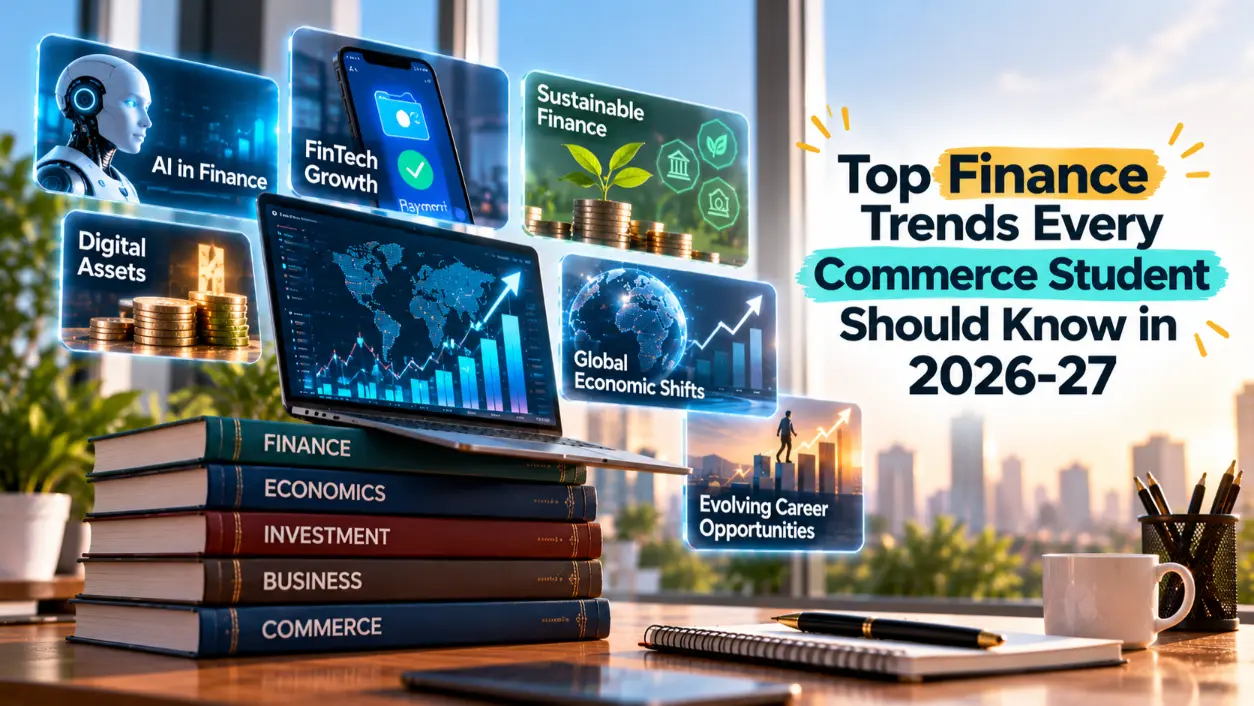
Finance is moving faster than most commerce classrooms are. The roles that companies are hiring for in 2026 and 2027 look different from what was standard five years ago, and the skills those roles require are different too.
For a commerce student choosing a program, preparing for placements, or planning a career direction, knowing where the industry is going matters as much as knowing the fundamentals of where it has been.
Here are the trends reshaping finance and accounting in India right now, and what each one means for your education and career choices.
1. AI and Automation Are Now Part of Daily Finance Work
This is no longer a future prediction. According to Robert Half's Finance and Accounting Trends Report 2026, AI and automation are now part of everyday finance processes including forecasting, reconciliation, anomaly detection, and audit preparation.
What this means for students: the value of a commerce graduate is shifting from manual data entry and report compilation toward interpretation, judgment, and oversight of AI-generated outputs. Students who understand both the accounting principles and the tools companies use to apply them will be significantly more employable than those who know only one.
2. FinTech Is Mainstream, Not Niche
According to IBEF (India Brand Equity Foundation), India now has over 14,500 FinTech firms and a digital-first financial services sector growing rapidly across banking, insurance, and wealth management. UPI alone processes the majority of India's digital transactions across more than 700 participating banks and payment service providers.
The consequence for commerce students is practical. Financial roles in banks, NBFCs, consulting firms, and corporate finance departments increasingly expect graduates to understand digital payment infrastructure, lending technology, and financial data systems, not just traditional accounting.
Students who want to work in this space should be exploring programs that include digital banking, FinTech applications, and financial analytics as part of their curriculum rather than as optional add-ons.
3. FP&A Roles Are Expanding Rapidly
Financial Planning and Analysis (FP&A) is one of the fastest-growing function areas in Indian corporate finance right now. As The Hans India reported in June 2026, the expansion of Global Capability Centres (GCCs) in India is creating rising demand for higher-value finance roles, specifically FP&A and business partnering.
FP&A professionals do not just record what happened financially. They forecast what will happen, analyse variance between plans and actuals, and support business decisions with financial models. It is a role that rewards analytical thinking and MIS skills alongside accounting knowledge.
For students interested in this direction, understanding what MIS reporting involves and why it matters is the starting point before the more advanced FP&A skill set builds on top of it.
4. ESG Reporting Is Becoming a Compliance Requirement
Environmental, Social, and Governance (ESG) reporting has moved from a corporate responsibility talking point to an actual business function. As Robert Half's 2026 report notes, ESG reporting expectations are increasing and companies are building internal teams to manage sustainability disclosures, social impact tracking, and governance documentation.
For commerce students, this opens a career path that did not meaningfully exist five years ago. ESG analysts and sustainability reporting specialists sit at the intersection of accounting, compliance, and strategic planning. The role requires financial reporting skills alongside an understanding of regulatory frameworks and business ethics.
Students who are looking for finance careers that go beyond traditional accounting should be aware that ESG reporting is one of the clearest growth areas through 2027 and beyond.
5. Risk and Compliance Functions Are Growing
Every expansion of digital finance creates a corresponding expansion in risk exposure. AI-driven credit assessment, digital lending, and embedded finance all require professionals who understand what can go wrong and how to build systems to prevent it.
The Hans India's June 2026 coverage of commerce career trends specifically identifies risk consulting as one of the emerging strong areas for commerce students in 2026. Roles like Risk Analyst, Compliance Officer, and Regulatory Technology (RegTech) Specialist are appearing in hiring pipelines that would previously only have considered engineering or legal graduates.
Understanding financial risk, regulatory frameworks, and compliance reporting is increasingly a core skill for finance professionals rather than a specialisation.
6. Data Analytics Is Now a Core Finance Skill
Finance teams across industries are using Power BI, advanced Excel, and increasingly AI-assisted tools to build dashboards, generate reports, and support decision-making. This is not restricted to technology companies. Manufacturing, banking, FMCG, logistics, and healthcare finance teams all use these tools regularly.
As Robert Half's 2026 report identifies, skills gaps in data-driven finance roles are deepening and prompting more upskilling initiatives across organisations. That gap is an opportunity for graduates who arrive with these skills already developed.
Students who want to stay relevant through 2027 and beyond need tool proficiency built before they graduate, not learned on the job.
What These Trends Mean for Your Education Choices
Reading a list of trends is useful. Translating them into a decision about which program to choose is where the actual value sits.
The trends above collectively point in one direction: finance careers in 2026 and 2027 reward graduates who combine foundational accounting and management knowledge with applied tool proficiency, data literacy, and an understanding of digital financial systems.
A standard B.Com or MBA that covers theory without tools and does not address AI, FinTech, or analytics integration is preparing students for a version of the job market that is already changing.
Programs that build these skills alongside academic foundations are what the trends above are actually calling for.
Our Smart B.Com + CAM program builds corporate accounting skills with Tally, GST, MIS, and advanced Excel integrated from the start. Our Smart MBA + PGDM in Finance and FinTech directly addresses the FinTech, digital banking, risk, and analytics trends, with AI tools built into the curriculum as a core component rather than an afterthought.
Conclusion
Finance in India is not slowing down. It is diversifying, specialising, and becoming more technology-dependent with every year. The commerce students who will build strong careers through 2027 and beyond are those who understand these shifts early and choose their education accordingly.
Trend awareness is the first step. Program choice is the second. Career execution is the third.
To explore which program at Nilaya best positions you for the finance landscape of 2026-27, visit nilayaeducation.org or call +91 97 3000 5000.