
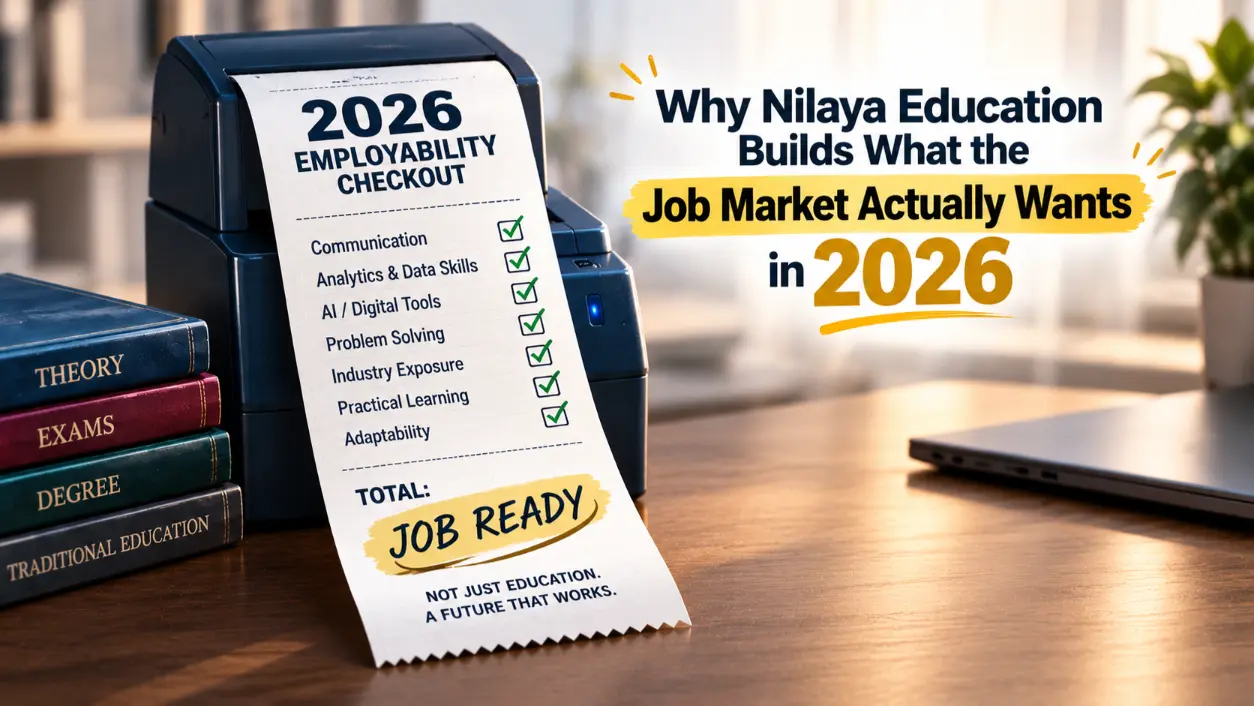
There is a number that every student and parent considering higher education in India should know.
Only 9% of India's finance aspirants feel their skills are ready to compete in an AI-driven job market, compared to 67% of graduates globally. This is from the Finance Talent Pulse 2026 study, published in The Tribune.
That gap is not because Indian students are less capable. It is because most Indian colleges are still preparing students for a job market that existed five years ago.
At Nilaya Education, our entire curriculum is built around the one question that matters most: what does the job market actually need from a commerce or management graduate in 2026, and how do we make sure every student we train can deliver it?
This blog answers that question across both branches of education we offer, commerce and business, and across every dimension of what we build: practical skills, AI and technology literacy, industry tools, and corporate exposure.
The Market Reality No Brochure Talks About
The numbers in 2026 tell a clear story.
According to the Taggd India Decoding Jobs Report 2026, demand for advanced digital skills has surged 42% year-on-year. AI and GenAI skills alone have seen a 3X rise in job postings across sectors including BFSI, finance, consulting, and operations.
The Government of India's PIB report on AI adoption, citing NASSCOM and McKinsey data, confirms that 87% of Indian enterprises are now actively using AI solutions, and 88% of organisations surveyed are using AI in at least one business function.
The demand is real. The supply of ready graduates is not.
Most commerce and management programs in India continue to teach accounting, marketing, and management as they were taught a decade ago. Tools have changed. Workflows have changed. The skills required on day one of employment have changed. The curriculum largely has not.
This is the gap we built Nilaya to close.
Two Branches, One Philosophy
Nilaya offers programs across two distinct branches, both built on identical foundational principles.
Commerce Branch:
- CAM: Corporate Accounts Manager (7-month professional diploma)
- CAFM: Corporate Accounts and Finance Manager (1-year advanced diploma)
- Smart B.Com + CAM (3-year dual degree)
Business Branch:
- Smart BBA (3-year dual degree)
- Smart MBA + PGDM in Finance and FinTech (2-year dual degree, postgraduate)
Whether a student is pursuing a commerce career in accounting, taxation, and finance, or a business management career in marketing, HR, operations, or FinTech, the approach inside the classroom is the same: practical first, tools always, AI-integrated throughout.
Practical Learning: What It Actually Means at Nilaya
The word "practical" is used by almost every institution in India. At Nilaya, it has a specific and verifiable meaning.
No theory without application. Every concept is taught in the context of how it is used in corporate environments. Journal entries are practised in live accounting software. GST is filed on real portals. Business strategies are built through real case studies. Marketing plans are developed for actual business scenarios.
Live projects and documentation. Students work with real financial documents, taxation forms, business reports, and corporate workflows. By the time they graduate, they have built a body of actual work, not a collection of exam answers.
Assessments based on output. Performance is evaluated on what students can produce and demonstrate, not only on what they can recall in a written exam. This shifts the entire learning orientation from memory to capability.
Small batches of 40 students per program. This is not a brochure claim. It is an operational commitment. With 40 students per batch, every student is known by name, tracked individually, and mentored throughout the program. No one gets lost in a large cohort.
AI Skills: What We Build and Why
The 9% AI-readiness figure cited above is a crisis number. It means the overwhelming majority of commerce and finance graduates in India enter the job market without the AI literacy employers are specifically looking for.
At Nilaya, AI skills are integrated into the curriculum as applied, practical competencies. Not as a separate module students complete and forget. As tools woven into how they learn and work throughout the program.
Across both branches, students develop:
AI-assisted financial analysis and reporting. Learning to use AI tools to interpret financial data, build MIS dashboards, and generate management reports faster and more accurately than manual methods allow.
AI-enhanced business communication. Using generative AI tools appropriately for business writing, report drafting, and client communication, while developing the human judgement to review, contextualise, and improve AI outputs.
AI literacy for business decision-making. Understanding how AI is being used in finance, banking, marketing, and operations environments so that graduates can participate meaningfully in AI-integrated workplaces rather than being intimidated by them.
Digital and data fluency. The ability to read, interpret, and present data in structured formats that support business decisions is one of the clearest differentiators between employable and unemployable graduates in 2026.
Tool Proficiency: The Specific Tools We Build
Being able to name a software on a resume is different from being able to use it under professional conditions. At Nilaya, tool training is hands-on, lab-based, and assessed through actual output.
Commerce branch tools:
- Tally Prime: Full accounting cycle from journal entries to financial statements
- Advanced Excel: Pivot tables, VLOOKUP, MIS dashboards, financial modelling formulas
- GST Portal: Live filing, reconciliation, and compliance workflows
- SAP (CAFM): SAP FICO for finance and controlling in corporate ERP environments
- Power BI (CAFM): Financial data visualisation, interactive dashboards, variance reporting
Business branch tools:
- Advanced Excel: Business analytics, data interpretation, and reporting
- Digital marketing platforms: Used in Smart BBA for marketing and sales applications
- SAP and ERP systems: Business operations and process management at MBA level
- AI tools: Applied across both branches for research, reporting, and business productivity
- Power BI: Financial and business analytics at MBA and PGDM level
The combination of Tally, Excel, SAP, Power BI, and AI tools is what companies expect from finance and management professionals entering mid to senior roles. We do not teach about these tools. We train students to use them.
Industry Exposure: Before Graduation, Not After
One of the most consistent complaints employers have about fresh graduates is that they have never actually been inside a corporate environment before joining one. Industry knowledge from a textbook and industry knowledge from experience are two fundamentally different things.
At Nilaya, industry exposure is structured into the program, not left to chance.
Industry visits: Students visit corporate offices, manufacturing units, banking facilities, and business operations as part of their scheduled learning. These are not ceremonial tours. They are structured observations that connect classroom concepts to real business environments.
Guest sessions with working professionals: Regular interactions with CAs, CFAs, banking professionals, finance managers, and corporate leaders who bring current, real-world knowledge into the classroom. Students learn not just theory but context.
Learn From Leaders (LFL) program: A structured series of sessions with senior professionals across industries that gives students direct access to the thinking, decision-making frameworks, and career trajectories of people who are already where students want to be.
Internship integration: Students gain real industry exposure through internships that are part of the curriculum, building work experience and professional confidence before graduation.
Faculty from industry backgrounds: Our faculty are Chartered Accountants, Company Secretaries, CFAs, LLBs, and professionals who bring direct corporate experience to every class. Their teaching is grounded in how finance and business actually work, not how textbooks say they work.
3C Development: The Professional Foundation Beneath Everything
Technical skills and tools are necessary. They are not sufficient.
Every program at Nilaya integrates 3C Development throughout: Confidence, Communication, and Computer Skills. This is not a personality development workshop bolted onto the end of the year. It is a structured, ongoing component of how students grow across the entire program duration.
Students go through:
- Communication training from week one, building business writing, presentation, and professional interaction skills progressively
- Grooming and professional etiquette development for corporate environments
- Mock interviews and aptitude training as a continuous process, not a last-minute rush
- Stage performances and public speaking exercises that build the confidence required for client-facing and management roles
The outcome is a graduate who can walk into a professional environment, interact confidently with senior colleagues and clients, and represent themselves and their organisation well. This is one of the skills employers consistently say is hardest to find in fresh graduates, and one of the things we are most deliberate about building.
What This Produces
Since 2008, over 10,000 students have completed programs at Nilaya and entered careers at more than 1,000 companies including UBS Switzerland, Deutsche Bank, KPMG, EY, ICICI Bank, Kotak Mahindra Bank, BNY, and Cognizant across roles in accounts, finance, banking, marketing, HR, operations, and management.
Every program carries a 100% Placement Guarantee on Stamp Paper, a legally backed commitment reflecting our confidence in the outcomes we consistently deliver.
Conclusion
The job market in 2026 is specific about what it needs. AI literacy. Tool proficiency. Applied skills. Corporate readiness. The ability to contribute from day one.
These are not optional extras for graduates who want to stand out. They are the baseline expectations of employers who are already working with AI tools, ERP systems, and data-driven workflows every day.
At Nilaya, both our commerce and business programs are built around this reality. Practical learning that produces actual capability. AI integration that builds real literacy. Tools training that creates genuine proficiency. Industry exposure that makes the corporate environment familiar before students step into it professionally.
To know more about which program fits your profile and career direction, visit nilayaeducation.org or call +91 97 3000 5000.