

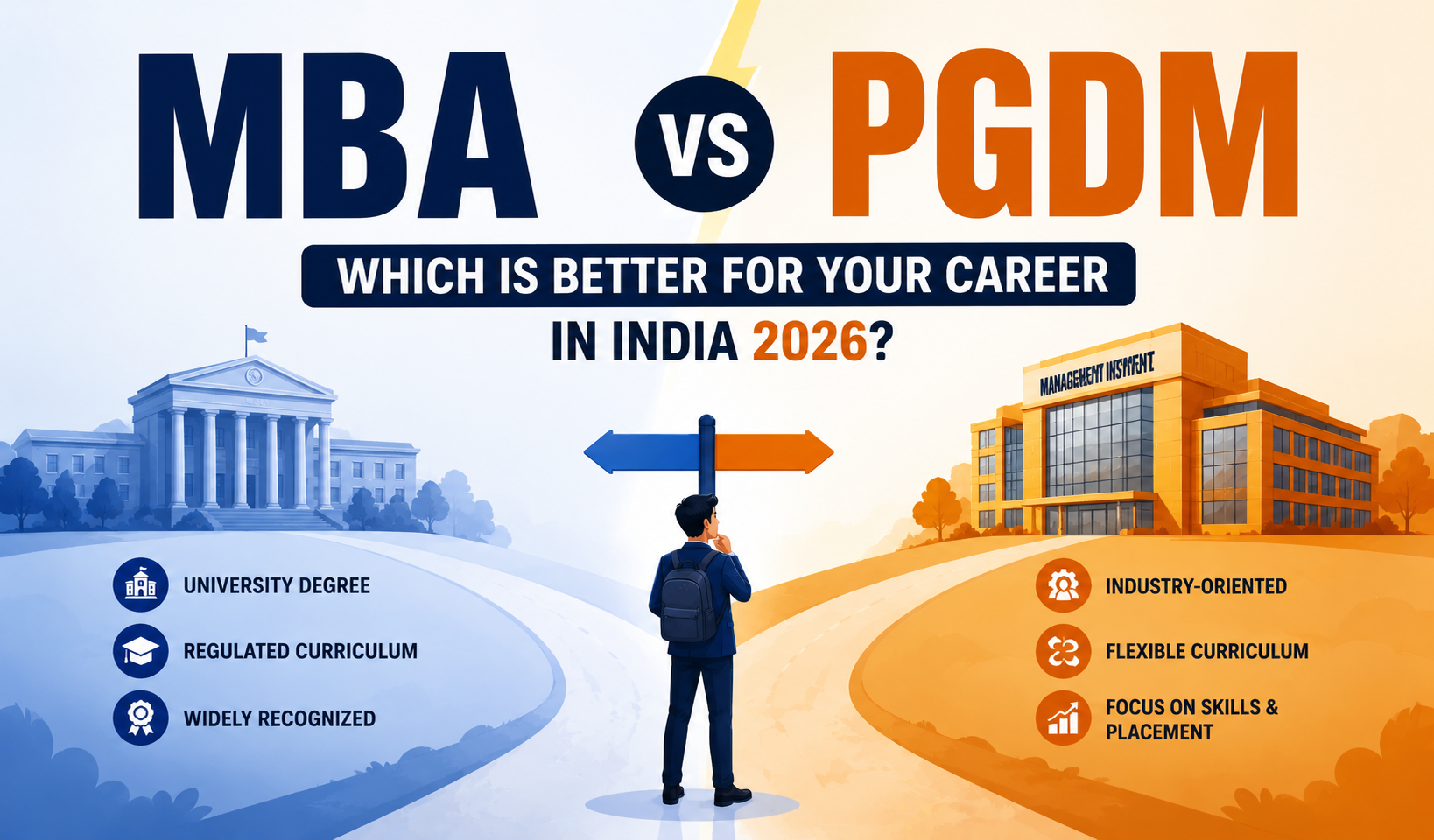
Every year, thousands of graduates in India face the same question after completing their undergraduate degree: MBA or PGDM?
Both are postgraduate management programs. Both lead to careers in finance, marketing, strategy, and business leadership. Both are pursued by students who want to move into meaningful corporate roles. And yet, they generate enormous confusion – because on the surface they look nearly identical, while the differences underneath matter significantly for your career.
This blog breaks down exactly what each qualification is, how they differ in structure and recognition, what the salary data says, and – most importantly – what the right question actually is when you are making this decision.
What Is an MBA?
An MBA – Master of Business Administration – is a postgraduate degree awarded by a university. In India, MBA programs are affiliated with universities recognised by the University Grants Commission (UGC) and follow a structured, university-approved syllabus.
Because it is a university degree, an MBA carries formal academic recognition across India and, in most cases, internationally – making it particularly relevant for students who plan to pursue government sector roles, PhD programs, or higher education abroad.
MBA programs typically run for two years and cover broad management subjects – finance, marketing, operations, human resources, strategy, and business economics. The structure is academically rigorous and follows a curriculum set by the affiliating university, which ensures consistency but also limits how frequently the content can be updated.
What Is a PGDM?
A PGDM – Post Graduate Diploma in Management – is a diploma-level qualification offered by autonomous business schools and institutions approved by the All-India Council for Technical Education (AICTE). Because PGDM institutions are autonomous, they are not bound by a university-defined syllabus. This allows them to design and update their curriculum far more flexibly – introducing practical modules, live projects, and specialisations that reflect current industry requirements.
The key distinction lies in the awarding body and regulatory framework: an MBA is a degree governed by UGC, while a PGDM is a diploma regulated by AICTE. In 2026, most corporate recruiters treat both qualifications as equivalent when evaluating candidates – the institution’s reputation and program quality matter far more than the degree label.
The word “diploma” often causes students to assume a PGDM is lesser than an MBA. This is a misconception. India’s most respected management institutions – including several IIMs, XLRI, and SPJIMR – award PGDM qualifications, not MBA degrees. The program’s value comes from its design and institutional credibility, not its title.
The Real Differences That Actually Matter
1. Regulatory Recognition
An MBA is recognised by UGC – the government body overseeing university education in India. This makes it the stronger choice for students targeting government jobs, academic careers, or international higher education programs that specifically require a university degree.
A PGDM is recognised by AICTE and is widely accepted across private sector employment. For government sector roles or PhD applications, a PGDM may require AIU (Association of Indian Universities) equivalence recognition, which many reputed AICTE-approved institutions obtain.
In 2026, the industry largely views both qualifications as equal if the PGDM institute is AICTE-approved and has AIU equivalence. The debate is less about the title and more about the transformational value of the program.
2. Curriculum Flexibility
This is where PGDM holds a structural advantage. Because autonomous institutions design their own curriculum, PGDM programs can be updated annually to reflect what industries actually need – introducing FinTech, digital business, analytics, AI applications, and applied management skills in ways that university-affiliated MBA syllabi often cannot accommodate quickly.
MBA programs follow a structured, university-defined curriculum that ensures academic depth but is slower to evolve with industry changes. According to Education For All In India’s comparative analysis, in 2026 many aspirants prefer PGDM for its flexible, modern approach as industries move fast and new skills are needed every few months.
3. Practical vs Academic Orientation
MBA is classical, university-style, and theory-heavy – slower to adapt to industry changes. For private sector, startups, consulting, and high-growth corporate careers, PGDM usually delivers better practical exposure.
This distinction is not absolute – a well-designed MBA program can be highly applied, and a poorly designed PGDM can be overly theoretical. What matters most is whether the institution has genuinely committed to practical learning, not which acronym it awards.
4. Fees
MBA programs at university-affiliated colleges are generally more affordable due to government funding support and regulated fee structures. PGDM programs at autonomous institutes are typically priced higher, reflecting the investment in curriculum design, industry partnerships, faculty recruitment, and placement infrastructure.
The fee difference does not automatically indicate a value difference. It reflects the type of institution – and in many cases, higher-fee PGDM programs at reputable institutions deliver stronger placement outcomes because of the resources invested in student development.
What Does Salary Data Say in 2026?
This is the question most students want answered directly.
According to salary data from Glassdoor India (May 2026), MBA graduates in finance roles earn an average of ₹4.93 LPA at entry level, with finance and analytics roles at IIM-level institutions reaching ₹8-12 LPA and investment banking tracks going significantly higher. Across specialisations, MBA starting salaries for freshers typically fall in the ₹5-8 LPA range at reputable institutions.
AmbitionBox salary data (May 2026) shows that MBA marketing roles average ₹12.2 LPA, while operations and HR roles start lower and grow with experience. Both MBA and PGDM graduates who reach senior management positions see packages ranging from ₹20-35 LPA, with the college’s reputation being the single biggest determinant of salary at every level.
The consistent finding across neutral salary platforms – Glassdoor, AmbitionBox, and PayScale India: both MBA and PGDM graduates earn comparable salaries at equivalent career stages. The institution and program quality determine salary outcomes – not the degree label.
The Question Most Students Miss
Most students spend their time comparing MBA vs PGDM as abstract categories. The more useful question is this:
Within whichever management program you choose – what practical skills will you actually build, and what career support will you receive?
A management graduate who finishes two years with strong theoretical knowledge but limited applied skills, no real tools experience, and no structured placement support will struggle – regardless of whether their certificate says MBA or PGDM.
A management graduate who finishes two years with industry-relevant skills, technology proficiency, communication confidence, and backed placement support will have strong early career outcomes – again, regardless of the label.
This is the insight that shaped the design of the Smart MBA + PGDM in Finance and FinTech at Nilaya Education.
How Nilaya’s Smart MBA Answers This Question
Nilaya’s Smart MBA program is a dual degree – combining an MBA with a PGDM in Finance and FinTech. Students receive both qualifications simultaneously, rather than choosing between them.
This structure was built around a straightforward reality: the MBA provides academic recognition and analytical depth, while the PGDM in Finance and FinTech provides the curriculum flexibility and practical specialisation that modern finance and management roles require. Together, they deliver what neither qualification alone can fully provide.
The Smart MBA + PGDM covers:
Financial Management and Strategy – Core MBA-level management and finance fundamentals, taught with a focus on real business application, not only conceptual frameworks.
Finance and FinTech Specialisation – Digital banking systems, financial analytics, risk and compliance frameworks, technology integration in business finance, and emerging FinTech applications – built into the PGDM component and reflecting where the finance profession is actually moving.
3C Development – Confidence, Communication, Computer Skills – Treated as professional competencies throughout the program. Students go through structured communication training, mock presentations, interview preparation, and grooming as an ongoing part of their development.
Expert Faculty from Corporate Backgrounds – Chartered Accountants, Company Secretaries, CFAs, LLBs, and industry professionals teach from direct corporate experience – bridging the gap between classroom learning and workplace application.
Small Batches of ~40 Students – Ensuring every student receives genuine mentoring and individual career support.
100% Placement Guarantee on Stamp Paper – Since 2008, Nilaya has placed over 10,000 students across more than 1,000 companies including UBS Switzerland, Deutsche Bank, KPMG, EY, ICICI Bank, Kotak Mahindra Bank, BNY, and Cognizant.
For students evaluating affordability alongside quality: the Smart MBA + PGDM at Nilaya is available at ₹3.35-3.98 lakhs for both qualifications combined – compared to ₹10-20 lakhs for comparable programs at other institutions.
So Which Is Better – MBA or PGDM?
Neither, in isolation, is definitively better. The right answer depends on your goals:
Choose an MBA if:
- You are targeting government sector roles or academic careers where a formal UGC-recognised degree is specifically required
- You plan to pursue a PhD or higher studies abroad that require a university degree
- You prefer a structured, academically oriented learning environment
Choose a PGDM if:
- You want an industry-aligned, regularly updated curriculum that reflects current business needs
- You are targeting private sector roles in finance, consulting, FinTech, or management
- You value practical exposure, live projects, and applied learning over purely academic structure
Choose a Dual Degree (MBA + PGDM) if:
- You want both academic recognition and practical specialisation without sacrificing one for the other
- You are targeting finance or FinTech careers and want the depth of a specialised diploma alongside the breadth of an MBA
- You want the strongest possible profile for corporate placement with the security of a written guarantee
Conclusion
The MBA vs PGDM debate, when examined honestly, resolves to this: both are legitimate pathways to strong management careers. The label matters far less than the institution, the curriculum design, the practical exposure, and the career support system behind the qualification.
What matters most is not which acronym appears on your certificate – it is what you can actually do when you walk into your first corporate role, and how prepared you are to grow from there.
The Smart MBA + PGDM in Finance and FinTech at Nilaya Education is designed around this reality – combining academic recognition, practical specialisation, and structured placement support in a single, integrated program.
To know more about the Smart MBA + PGDM program, admission process, and fees, visit nilayaeducation.org or call +91 97 3000 5000.