
The Uncomfortable Truth About Management Graduates
Every year, thousands of MBA graduates enter the job market across India. They carry well-formatted resumes, two years of academic learning, and a reasonable understanding of marketing, operations, and finance theory.
And yet, a consistent pattern plays out in corporate hiring rooms across Pune, Mumbai, and Bangalore.
Interviewers ask candidates to walk through a real business problem. To explain how they would read an MIS report. To describe how a digital payment reconciliation works. To demonstrate what they would do in the first week of a finance role.
Many candidates with strong academic profiles struggle to answer these questions - not because they are unintelligent, but because their MBA never taught them how to apply what they studied in real situations. The curriculum was designed to build conceptual understanding. The corporate world, however, operates on applied competence.
This is not a criticism of MBA students. It is a structural problem with how most management education is designed.
What Corporate Life Actually Looks Like on Day One
Here is a reality that most MBA programs do not prepare students for: your first week at work will have nothing to do with Porter's Five Forces.
You will be handed a dashboard. You will be asked to prepare a business report. You will sit in a meeting where people speak in finance shorthand - MIS, P&L variance, digital reconciliation, risk compliance thresholds. You will need to operate tools, send structured communication, manage timelines, and contribute to decisions - often within the first few days.
The transition from academic life to corporate life is jarring for most MBA graduates precisely because the two environments operate on completely different terms. College rewards theoretical understanding and examination performance. Corporate environments reward applied ability, communication under pressure, and the speed at which a person can become independently useful.
Bridging that gap - really bridging it, not just talking about it in a prospectus - requires a fundamentally different approach to management education.
Why Traditional MBA Programs Are Not Enough Anymore
This is not a comfortable point to make, and it is worth making carefully.
Traditional MBA programs have genuine value. A rigorous two-year program teaches students how to think about business at scale, how to structure strategic decisions, and how to communicate complex ideas. These are real and lasting skills.
The problem is what traditional MBAs do not teach - and what the corporate world increasingly requires.
Finance roles today operate at the intersection of financial knowledge and technology. Digital banking, automated reporting, FinTech platforms, AI-driven analytics, and real-time risk monitoring are not the future of finance. They are the present. Companies building these systems - and established banks, NBFCs, and corporates adopting them - need management professionals who can work within these environments, not just understand them in the abstract.
Meanwhile, the soft skills gap is just as significant as the technical one. Communication, confidence, presentation under pressure, business writing, interview readiness - these are skills that do not emerge automatically from two years of coursework. Yet they are the first things employers notice, and the first things that determine whether a new hire becomes genuinely useful quickly or requires months of in-house remediation.
The result: capable students graduating from reputable programs and still spending their first six to twelve months at work playing catch-up.
What a Smart MBA Actually Does Differently
The Smart MBA at Nilaya Education was built around a simple but important question: what does a management graduate actually need to know and do in order to add value from the first month of employment?
The answer shaped a program that looks quite different from a conventional MBA - not in terms of academic rigour, but in how learning is structured and what it prioritises.
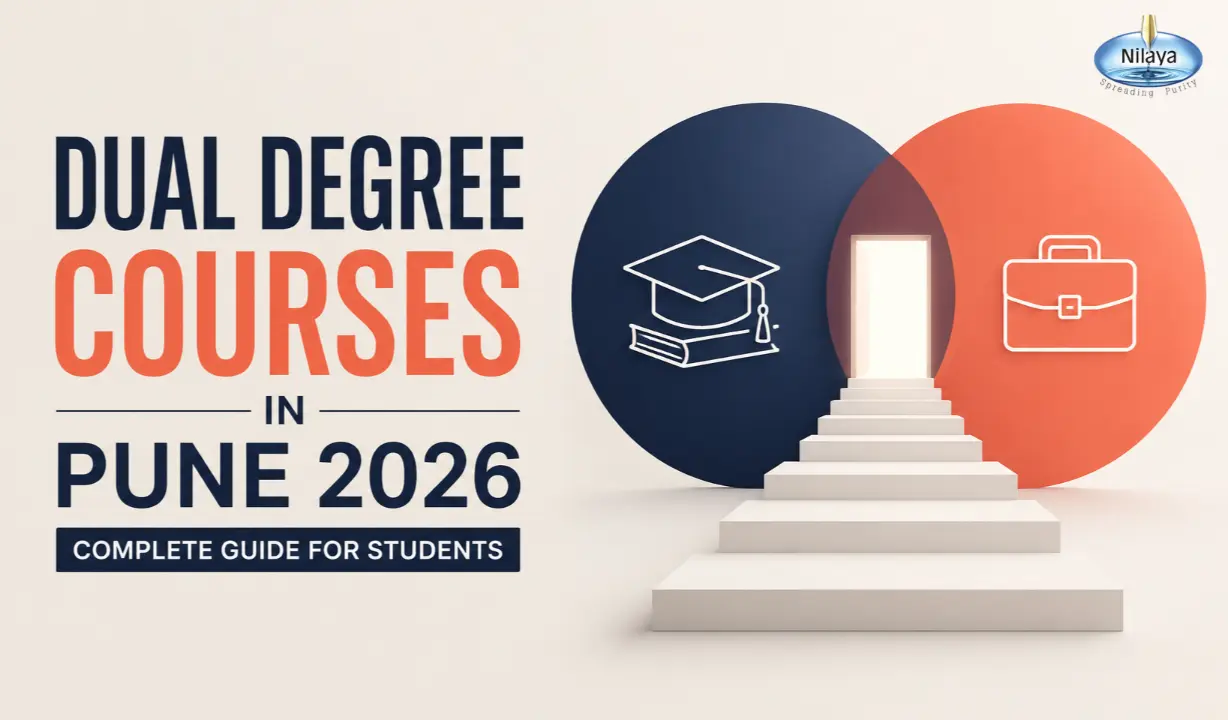
It combines two qualifications, not just one. The Smart MBA integrates an MBA program with a PGDM in Finance and FinTech, providing students with both broad management education and specialised knowledge in one of the fastest-growing fields in the economy. This dual degree structure means graduates are not choosing between business fundamentals and domain expertise - they are building both simultaneously.
The curriculum is built around what companies actually use. Learning areas include financial management and strategic planning, digital banking systems, financial analytics and data interpretation, risk assessment and regulatory compliance in digital finance, and technology integration in business operations. These are not elective topics or supplementary modules. They are core to the program - because they are core to what management professionals are expected to understand in today's organizations.
Every learning format is practical. Real case studies, live projects, simulations, and actual tools - not slides about tools, but training on tools that companies use. Students develop working familiarity with the systems and workflows they will encounter on the job, before they are on the job.
3C Development runs throughout the program. Confidence, Communication, and Computer Skills are treated as professional competencies, not optional extras. Students go through communication drills, mock presentations, grooming sessions, stage performances, and structured interview preparation as an ongoing part of their development - not as a final-semester addition.
Faculty bring corporate experience, not just academic credentials. Chartered Accountants, Company Secretaries, CFAs, LLBs, and industry professionals teach the program. Students learn how financial concepts are applied in real businesses - because their teachers have applied them in real businesses.
Small batches mean real attention. With approximately 40 students per batch, the learning environment is structured for genuine individual development. Every student receives mentoring, feedback, and the space to improve in areas they find difficult - rather than moving at the pace of a large, undifferentiated cohort.
The Gap This Program Is Designed to Close
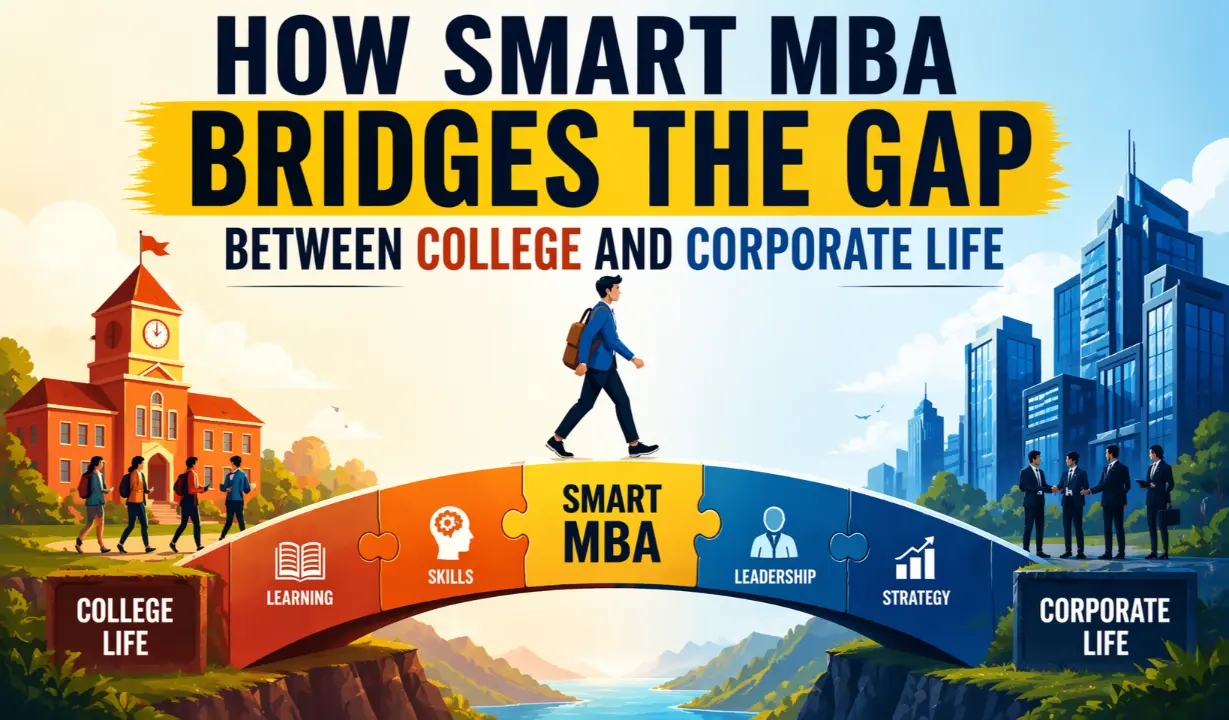
Think of the Smart MBA as a structured bridge - not just between college and a job, but between theoretical management understanding and the ability to function effectively in a corporate environment.
On one side: the academic world, where learning happens in classrooms, concepts are explored in theory, and success is measured in examinations.
On the other side: the corporate world, where success is measured in contribution, where communication and applied skill are visible immediately, and where the ability to learn quickly and independently matters more than grades.
Most MBA programs do their best work on the left side of that bridge. The Smart MBA is designed to build the right side - to ensure that students who graduate have already begun the transition, so that their first corporate experience is not disorienting.
Students from Nilaya's Smart MBA program have gone on to work in roles spanning Financial Analyst, FinTech Consultant, Digital Banking Professional, Risk Analyst, and Business Analyst positions across companies including UBS Switzerland, Deutsche Bank, KPMG, EY, ICICI Bank, Kotak Mahindra Bank, BNY, Cognizant, and over 1,000 other MNCs and SMEs. Since 2008, more than 10,000 students across Nilaya's programs have been placed - and the institution backs this with a 100% placement guarantee on stamp paper, not as a marketing claim but as a legal commitment.
For Graduates Wondering Whether They Need an MBA at All
This is a question worth taking seriously.
The MBA has become, for many graduates, an automatic next step - something people do because they are unsure what else to do after their undergraduate degree, or because they believe it will unlock a salary jump without quite knowing how.
That approach, applied to a poorly designed program, produces the outcome described at the start of this blog: graduates who have spent two years and significant money on a degree that leaves them unprepared for the work environment they are stepping into.
The right question to ask before choosing an MBA is not "should I do one?" but "what will this program actually make me capable of?" The answer to that question should be specific, verifiable, and tied to the reality of the roles you want to pursue.
If the answer involves a list of subjects covered and faculty names - but nothing about how learning is applied, what tools students work with, what career outcomes actually look like, or how the program bridges the gap between classroom and workplace - it is worth thinking carefully before committing.
Conclusion: Bridging the Gap Is the Whole Point
The gap between college and corporate life is real. It shows up in interviews, in first weeks at work, in the time it takes new hires to become independently useful. It costs graduates opportunities and costs companies productivity.
Management education that takes this gap seriously - that is designed explicitly to close it - looks different from conventional MBA programs. It is more applied, more practically structured, and more honest about what corporate environments actually require.
The Smart MBA at Nilaya Education is built on this philosophy. Not to replace strong academic foundations, but to pair them with the professional competencies, technology fluency, and communication skills that turn a qualified candidate into a genuinely effective one.
For graduates in Pune and across Maharashtra who are asking what their MBA should actually do for their career - this is one program worth understanding in full.
To learn more about the Smart MBA + PGDM in FinTech, visit nilayaeducation.org or call +91 97 3000 5000.