

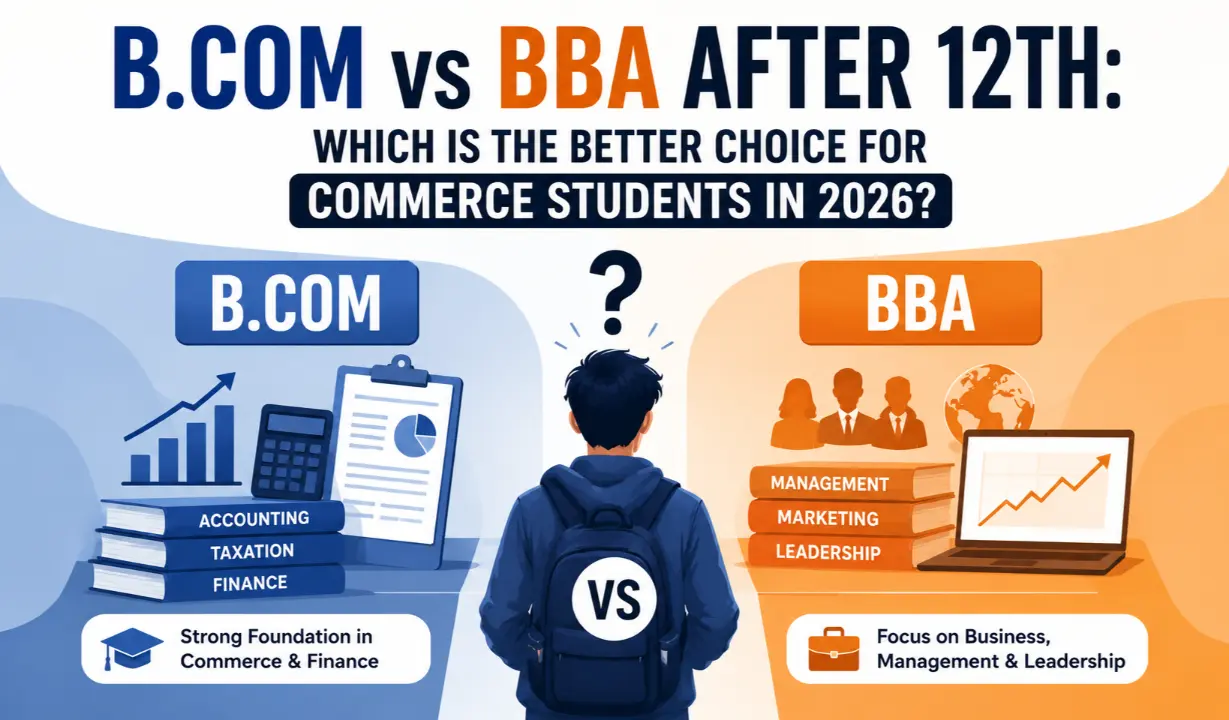
Maharashtra HSC results are out. The question that follows for almost every commerce student is the same: B.Com or BBA?
Both are three-year undergraduate degrees. Both are open to commerce students after 12th. Both lead to careers in business. And yet, they are built around fundamentally different ideas of what a business career looks like and choosing the wrong one for your goals can cost you years of time and direction.
This guide does not pick a winner. It explains exactly what each degree is designed to do, who it suits, and what the job market actually looks like at the end of each path - so you can make the decision that is right for you.
What Is B.Com and What Does It Prepare You For?
Bachelor of Commerce is the most traditional and widely pursued undergraduate degree for commerce students in India. It builds a structured understanding of how money, business, and financial systems work - covering subjects like financial accounting, business economics, taxation, auditing, corporate law, and cost accounting across three years.
The foundation B.Com provides is analytical and finance-oriented. Students develop the ability to work with numbers, understand financial regulations, interpret business data, and manage accounts and compliance processes.
This makes B.Com a natural starting point for students who want careers in:
- Accounting and financial operations
- Banking and financial services
- Taxation and GST compliance
- Auditing and corporate finance
- Professional routes like CA, CS, CMA, and CFA
B.Com is also one of the most compatible undergraduate degrees for students preparing for MPSC, IBPS banking exams, SSC, and other government-sector examinations - because the core subjects of accounts, economics, and business law overlap directly with the syllabus of most competitive exams in Maharashtra.
What Is BBA and What Does It Prepare You For?
Bachelor of Business Administration is a management-oriented degree built around how businesses are run rather than how finances within them are structured. The curriculum covers marketing, human resource management, business strategy, operations, entrepreneurship, organisational behaviour, and business communication.
BBA is designed for students who want to enter business-facing roles - those that involve managing people, handling customer relationships, building brands, running operations, or working in strategy and consulting.
Career paths after BBA typically include:
- Marketing executive and brand management roles
- Sales and business development
- Human resource management
- Operations and supply chain
- Business analytics and consulting
- Startup and entrepreneurship roles
BBA is also widely considered the strongest academic foundation for students who plan to pursue an MBA after graduation. The management concepts introduced in BBA align naturally with what MBA programs build on, making the transition more structured and effective.
The Core Difference: Finance vs Management
The simplest way to understand the difference between B.Com and BBA is this:
B.Com asks: How does money work inside a business? BBA asks: How does a business work overall?
A B.Com graduate understands accounts, taxation, compliance, and financial reporting. A BBA graduate understands teams, markets, strategy, and operations.
Neither is superior. They serve different professional goals. The confusion arises because both deal with "business" — but they deal with very different parts of it.
Salary: What Does the Market Pay in 2026?
This is the question most students and parents want answered first, and the honest answer is that salary after graduation depends less on which degree you chose and more on what skills you built alongside it.
That said, here is what the market data shows for 2026:
According to data published by upGrad, BBA graduates tend to move into management-track roles faster, with entry-level salaries typically ranging from ₹2.5 to ₹5.5 LPA. B.Com graduates entering finance and accounting roles see starting salaries in the ₹2.5 to ₹5 LPA range, with significant growth possible when professional certifications or practical diplomas are added to the profile.
findmycollege.com notes that BBA graduates with an MBA can reach ₹12–20 LPA over time, while B.Com graduates with CA qualifications or specialised finance certifications can reach comparable figures in finance and accounting leadership roles.
The pattern is consistent across multiple sources: the degree is the foundation, but the practical skills, tools knowledge, and professional certifications layered on top of it determine where your salary actually goes.
This is precisely why at Nilaya Education, both the Smart B.Com and Smart BBA programs are designed as dual degree courses - pairing the university degree with structured professional skill development, industry tools training, and 100% placement support, rather than leaving students to figure out the skills gap on their own after graduation.
B.Com at Nilaya: What Smart B.Com + CAM Offers
Nilaya's Smart B.Com program combines the complete SPPU-affiliated B.Com degree with a CAM - Corporate Accounts Management professional diploma. This is not a regular B.Com with an added module. It is a structured dual degree where the B.Com academic syllabus and the CAM practical curriculum run together across the program.
The CAM diploma covers hands-on training in corporate accounting, GST filing, income tax compliance, MIS reporting, banking operations, and finance tools including Tally and advanced Excel - the actual workflows used in corporate finance and accounts departments.
Students graduating from Smart B.Com + CAM leave with:
- An SPPU-recognised B.Com degree
- A professional CAM diploma with ABC credits
- 100% practical skills for immediate employment
- 100% job guarantee backed on stamp paper
- Structured placement support with early earning from the second year
Career outcomes include Accounts Executive, GST Analyst, MIS Executive, Tax Assistant, Finance Executive, Banking Executive, and Accounts Manager roles - with a strong base for higher education paths including CA, CS, CFA, MBA, UPSC, and MPSC.
BBA at Nilaya: What Smart BBA Offers
Nilaya's Smart BBA program takes the same philosophy - pairing academic recognition with genuine professional skill development and applies it to the BBA track. Students receive a university-recognised BBA degree alongside structured training in business communication, management skills, corporate exposure, and digital business tools.
Like the Smart B.Com, the Smart BBA is built for career readiness - not just degree completion. The same placement support infrastructure, small batch structure, 100% practical focus, and career guidance system that drives outcomes for B.Com students is applied to the BBA program.
So Which Should You Choose?
Here is a direct framework to help you decide:
Choose Smart B.Com + CAM if:
- You want a career in accounting, finance, banking, or taxation
- You are considering CA, CS, CFA, or a finance-focused MBA in the future
- You are preparing for MPSC, banking exams, or other competitive exams alongside graduation
- You prefer working with numbers, financial analysis, and structured compliance processes
- You want to start earning early through placement in accounts and finance roles
Choose Smart BBA if:
- You want a career in marketing, sales, business development, HR, or operations
- You are planning to pursue an MBA after graduation and want strong management foundations
- You enjoy presentations, team dynamics, strategy, and business communication
- You are interested in entrepreneurship or startup environments
- You see yourself in a business-facing role rather than a finance-specialist role
One Question That Decides Everything
If you are still unsure, answer this honestly:
On a regular Tuesday two years into your career - what kind of work do you want to be doing?
If the answer involves preparing financial reports, managing accounts, filing GST returns, or analysing financial data - B.Com is your foundation.
If the answer involves managing a team, pitching to clients, working on marketing campaigns, or running business operations - BBA is your foundation.
Both are strong career paths in 2026. India's expanding economy, growing FinTech sector, and demand for management and finance professionals means both B.Com and BBA graduates have real opportunities - provided they have built practical skills alongside their degree, not just an academic qualification.
Conclusion
The B.Com vs BBA question does not have a universal answer - it has a personal one. The right choice is the one that aligns with how you think, what kind of work you want to do, and where you want your career to be in five years.
What matters equally is how you pursue whichever degree you choose. A B.Com that only teaches theory without practical skills will not prepare you well. A BBA that focuses only on textbooks without real management exposure will not either.
Nilaya's Smart B.Com + CAM and Smart BBA programs are built around this reality - pairing recognised academic degrees with practical, career-focused skill development and genuine placement support. Since 2008, over 10,000 students have built careers through this model.
To understand both programs in detail, visit nilayaeducation.org or call +91 97 3000 5000 and speak with a counsellor directly.