
The companies that hire commerce and management graduates in 2028 and beyond will use AI for accounting, financial analysis, business reporting, and decision-making as a matter of routine. The graduates who thrive will not be those who understand AI in theory. They will be the ones who learned to work alongside it before they graduated.
This shift is already underway. Commerce and business education in India is at a turning point in how it responds.
Where Things Stand Right Now
India's AI investment is growing at a compounded annual rate of 30.8%, according to NASSCOM data on the Government of India's IndiaAI portal. This growth is not limited to technology. It runs through banking, finance, accounting, operations, and marketing, every domain that commerce and business graduates enter.
According to the Taggd India Decoding Jobs Report 2026, AI and GenAI skills are seeing a 3X rise in job postings across finance, BFSI, and consulting.
And yet, the India Skills Report 2026 cited by APAC News Network shows that 93% of students want more hands-on, experiential learning. Most classrooms are not yet providing it.
That gap is the problem education needs to close.
What Is Actually Changing
AI Is Entering Core Subjects, Not Just Electives
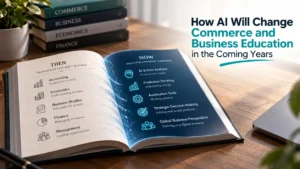
AI is no longer an optional add-on in commerce and business education. It is entering the core of how these subjects are taught and applied.
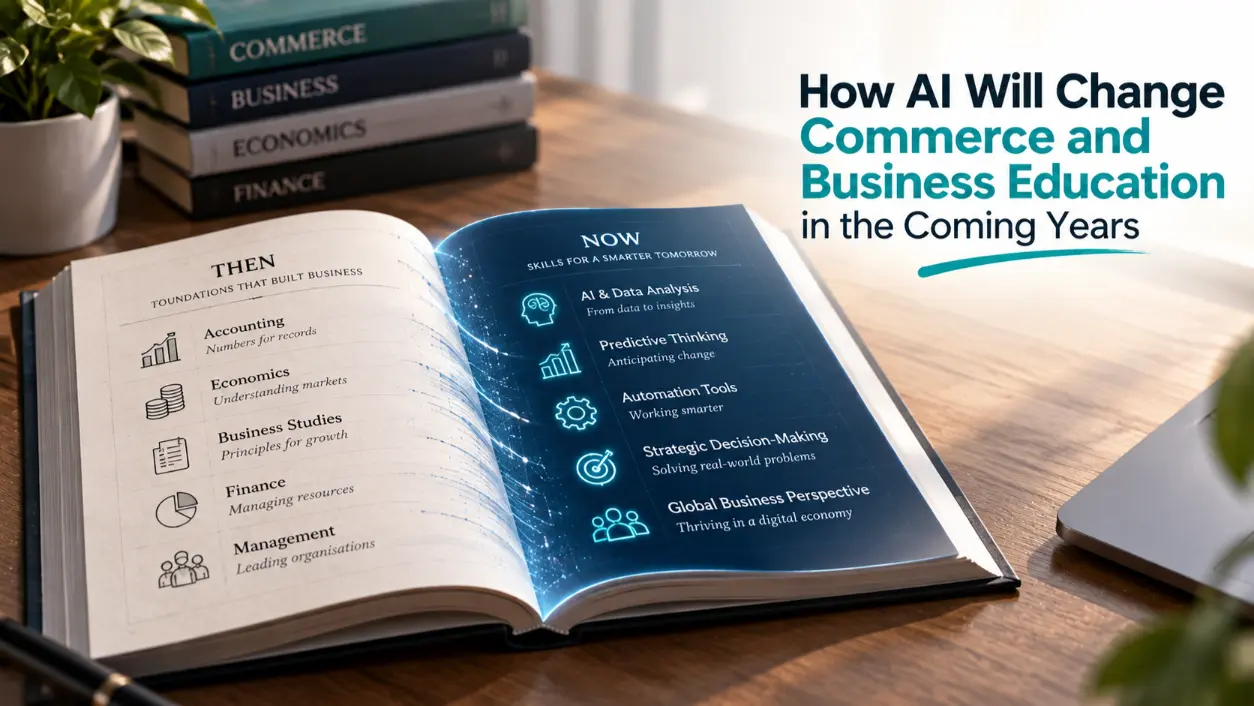
In accounting and finance: Tools like Power BI, AI-assisted Excel, and automated MIS dashboards are replacing manual report compilation. Students need to understand both the underlying principles and the tools used to apply them.
In marketing and business management: Generative AI is used for market analysis, customer segmentation, and campaign reporting. BBA and MBA students need to operate these tools alongside their strategic thinking.
In banking and financial services: Fraud detection, credit scoring, and risk management are increasingly AI-driven. Finance graduates who understand how these systems work are more valuable than those who only know the manual versions.
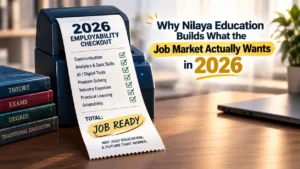
The Skills Employers Are Asking For
The skills required from commerce and business graduates in the coming years are not a replacement for foundational knowledge. They are an addition to it.
- Data literacy: Reading and acting on AI-generated reports and dashboards with business judgment, not just technical ability
- Tool proficiency: Working ability with Power BI, advanced Excel, Copilot, and sector-specific AI platforms
- Critical evaluation: Checking AI output for errors, contextualizing it, and presenting it meaningfully to decision-makers
- Communication and leadership: As AI handles more data processing, human skills become more valuable, not less
What This Means for Commerce Students
For students choosing a B.Com or accounting program, AI does not eliminate the need for accounting knowledge. It raises what that knowledge can do.
A commerce graduate who understands GST, MIS, and financial reporting already has employment value. One who also works fluently with AI-integrated tools has a career advantage that compounds over time.
The question for students evaluating B.Com programs is not whether AI is mentioned in the curriculum. It is whether the program actually trains students to use AI-integrated tools in the context of real accounting and finance work.
What This Means for Business Students
For BBA and MBA students, AI is reshaping what a business manager is expected to do. Managers who relied on teams to compile and present data will increasingly work with AI systems that surface that data automatically.
What companies need from managers in this environment:
- The ability to set the right questions and interpret what AI surfaces
- Strategic decisions that require human judgment, not just data processing
- Leadership through change as teams adapt to new tools and workflows
- Ethical decision-making in situations AI cannot resolve
Programs that build these skills alongside AI and technology proficiency produce graduates who are ready for where business is going, not just where it has been.
The Skill AI Will Never Replace
A point worth stating clearly: AI will not replace commerce and business graduates. It will replace graduates who only know how to do what AI can do.
Graduates who understand financial principles well enough to know when AI output is wrong, who can communicate strategy to a boardroom, and who make ethical decisions in complex situations: these graduates are more valuable in an AI-integrated world, not less.
How We Are Building Students for This at Nilaya
Across our commerce and business programs, AI integration is not a future plan. It is already part of how students learn.
Our Smart B.Com + CAM and CAFM programs integrate Power BI, advanced Excel, and AI-assisted MIS reporting into hands-on training throughout the program. Students work with these tools, not just read about them.
Our Smart BBA embeds AI tools into business communication, marketing analysis, and operations training.
Our Smart MBA + PGDM in Finance and FinTech covers AI-driven financial analytics, digital banking, and automated risk assessment as core curriculum.
The 3C Development framework (Confidence, Communication, Computer Skills) built into every program is specifically designed for this decade's job market, where AI handles data processing and the humans who thrive are those who can judge, communicate, and lead.
Our placements reflects the outcomes: 10,000+ students placed since 2008 across companies actively integrating AI into their daily operations.
Conclusion
AI is not a threat to commerce and business education. It is a redesign requirement.
Programs that treat AI literacy as foundational, paired with accounting, management, and finance knowledge, will produce graduates who are genuinely ready for the coming decade. Programs that treat it as optional will not.
To know more about how AI is integrated across our programs, visit nilayaeducation.org or call +91 97 3000 5000.